
The Hierophile #2

I have spent another week interred in my cavern of reading and writing and bring you some things both new and old to me. Much of what I read is scholarly, and some is highly theoretical and boring to most people. However, I have been lucky to come across some interesting things. I will be celebrating the new moon with praises to Erato, muse of erotic poetry, for I have found things fitting of Her worship. Reading about pornography never loses its spark for me, it can always provide a good laugh – especially when the author embraces it. Scholar Constance Penley, one of the founders of scholarly porn studies, does not shy away from sexual puns. It’s always a delight. Though her work isn’t overtly related to hierophilia, I would recommend her essay “Crackers and Whackers: The White Trashing of Porn” to anyone interested in the study of pornography. It was easy and fun to read, though I may be biased as it gave me reprieve from other, denser texts. Anyway, onto the priests and nuns.
Music: “Rev 22:20” by Puscifer
This is an absolute classic of my erotica writing playlist. There are two main versions of the track, the “Dry Martini Mix,” found on their first album, and the “Don’t Shoot the Messenger” version from the Don’t Shoot the Messenger EP. The track takes its title from the Bible verse of the same name, which reads in the KJV, “He which testifieth these things saith, Surely I come quickly. Amen. Even so, come, Lord Jesus.” Obviously, it plays on the double meaning of come in English, and the track is decadently sinful.
Don’t be aroused by my confession
Unless you don’t give a good goddamn about redemption
I know Christ is comin’, and so am I…
Jesus is risen, it’s no surprise
Even he would martyr his mama to ride to hell between those thighs…
The instrumental, especially in the Dry Martini version, all sultry and louge-like, works so well with the lyrics. I’m not a rabid Tool/Puscifer/Perfect Circle fan, but Maynard’s voice suits this song perfectly, with vibrato in the right place, low and sincere. He sells it. The post-chorus, spotted with heavy breaths, leads into a small piano breakdown that feels larger than it actually is. This song feels like such grand devotion without sounding big, rather, it seems like hushed confessions in a sacristy.
Here's the Dry Martini version, and the Don’t Shoot the Messenger version.
Literature: “The Autobiography of a Flea” (anonymous)
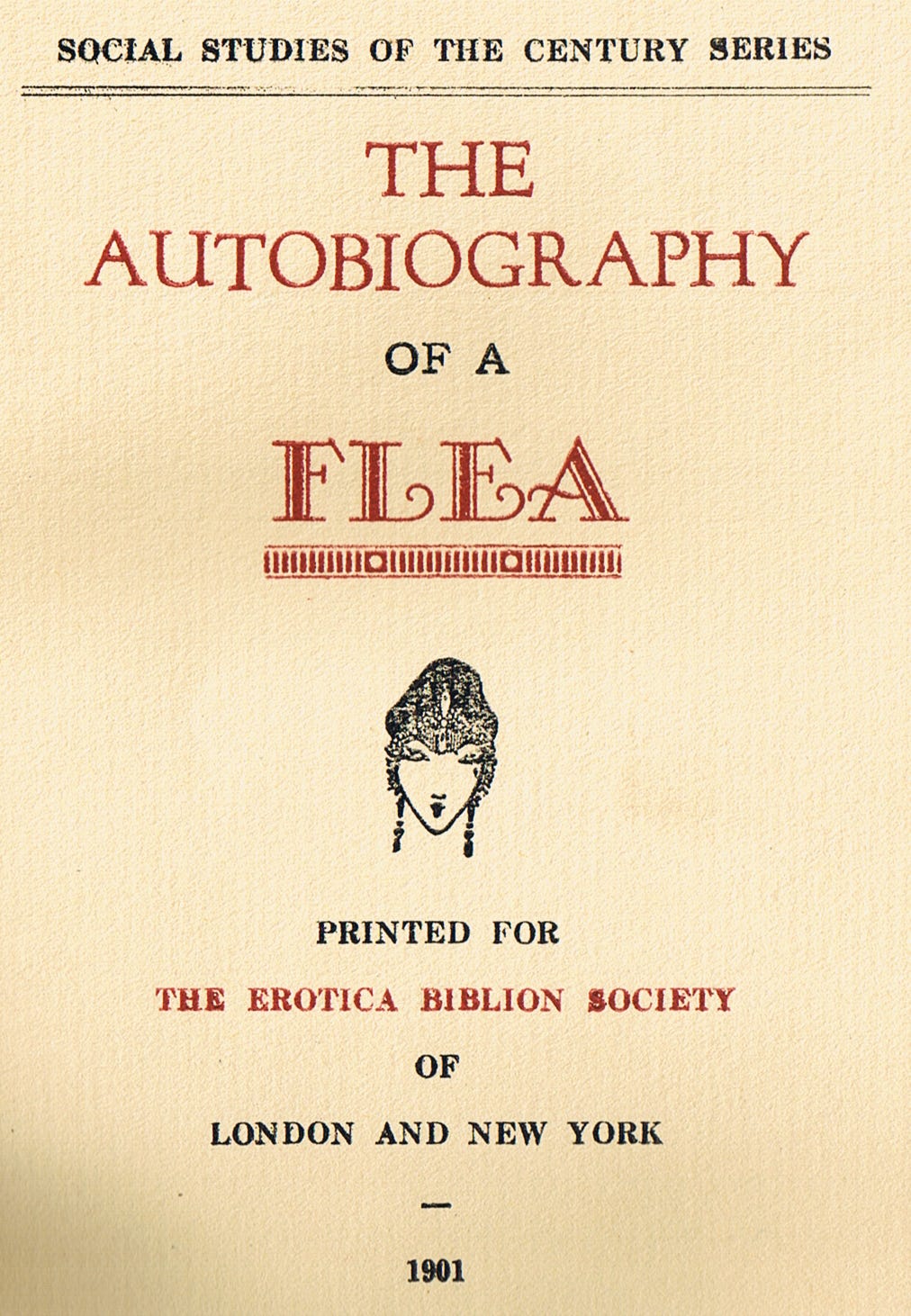
This strange Victorian erotica is, plainly, not very well written. However, it is intriguing, and perhaps, also worthy of other interests. It is written from the point of view of a flea on the body of Bella, a young woman, seduced into sexual sin. That whole flea thing makes it rather weird, and leads to some quirks, like the one that led me to the work in the first place: one priest’s penis is described as “menac[ing] the skies.” There’s not much I can say that can give credit to how absurd that is.
Bella goes from a simple fling with a young man to being split three ways between priests, to bringing her friend into debauchery, to becoming a nun who participates in splendorous orgies. This text uses a lot of the same tropes that I and my hierophile acquaintances use frequently in our writings, from blackmailing to scheming clergy only ordained for carnal pleasures. It’s revealed early that Father Ambrose, the one who catches Bella in the act and requests her private audience, orchestrated her interest in the young man Charlie, whom she slept with in the first place. All that to lead to her in his grasp. The flea calls Ambrose “the living personification of lust” and does so aptly. On their first meeting, they go two rounds.
This text does remind me, intriguingly, of the one I mentioned in the first letter, The Monk. Bella is a woman who has great sexual ignorance (perhaps feigned), and all clergy seem disposed to great sin, which is similar to Antonia in The Monk and all the horrid nuns of the convent of St. Clare.
Of course, there is some potentially triggering content in here, but you can read it here on Wikisource.
History: Saint John Henry Newman
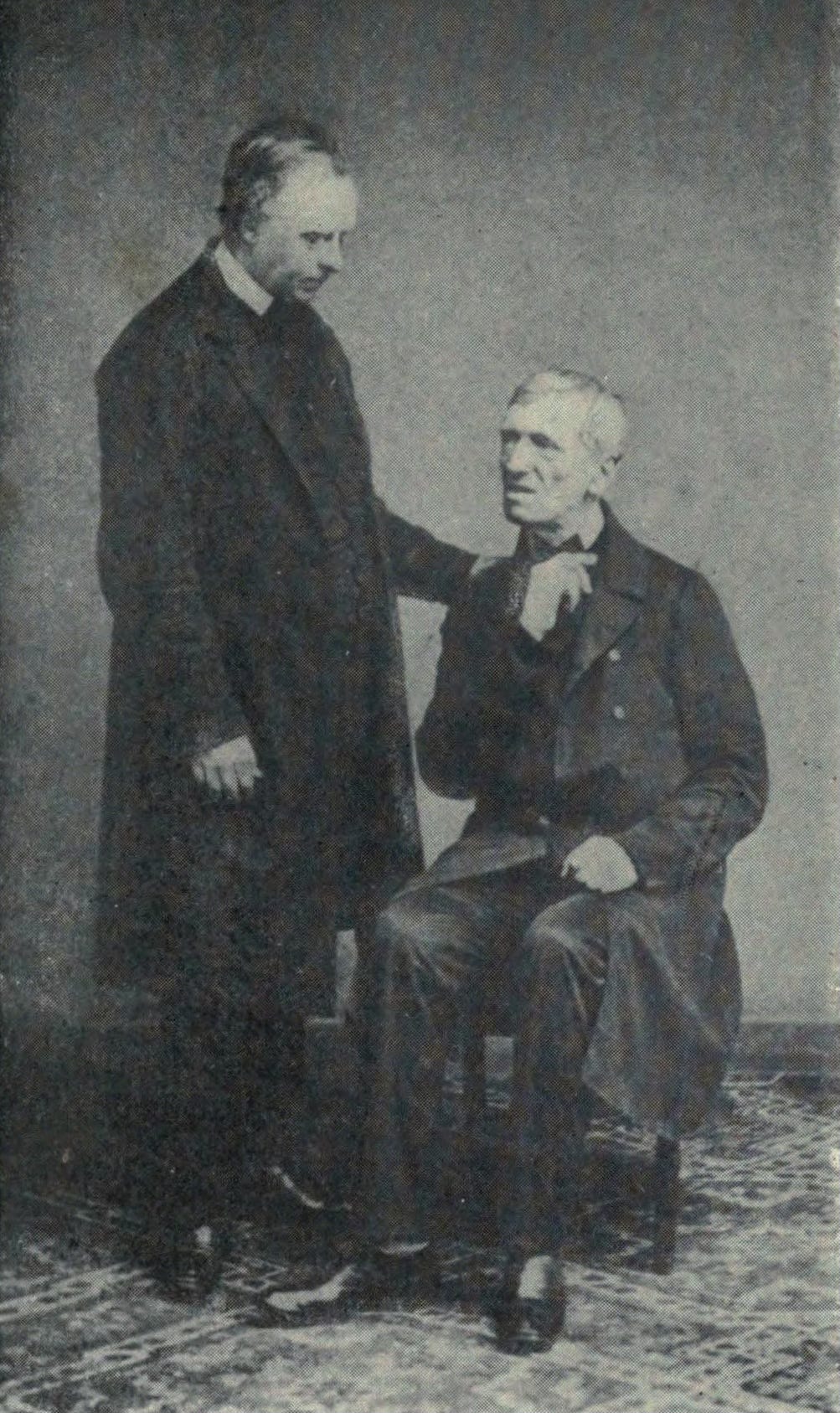
(St. John, left, and Newman, right)
John Henry Newman (1801-1890) is best known for his seminal work of apologetics, Apologia Pro Vita Sua, or “Defense of One’s Own Life.” This text came about after rage from Reverend Charles Kingsley really just went in on him in several publications for his assertions about Catholicism. Kingsley, was of course, Protestant, and said somewhat erroneously that Newman did not believe that truth was a virtue. The two spat for a while over letters, but Newman landed the killing blow, as it were, with the Apologia. Notably, Kingsley also threw some other accusations Newman’s way. Here, I am indebted in analysis to Peter O’Malley’s Catholicism, Sexual Deviance, and Victorian Gothic Culture. O’Malley points out that Kingsley often insinuates that Newman is an “attractor of young men” swayed by his rhetoric, his oratory “the arrow of Eros, penetrating the hearts of the ‘admiring young gentlemen’ who flock to hear him” (85-6). The thing is, Kingsley’s accusation of homosexuality has some basis.
Newman lived and was buried with another man, Father Ambrose St. John. Though he was celibate, the two had an extremely deep bond, which is presumed by many to be romantic. Despite the queer eye suggesting that two men who joined a position where they would not be expected to marry women and spent their whole lives together may have been romantically involved, many biographers and the Church really don’t like this interpretation. Yet, I cannot help but suspect it myself. Catholicism was seen as a place where sexual deviance could exist because it had secrets. The confessional. What could be more secret than such a love? Or perhaps, breaking of vows? Now, I don’t suggest that Newman did break his vows, but there’s always the what if…
Regardless, there is a tension in the existence of a celibate clergy. What motivation may one have for joining? Either one represses or escapes…which one is it?
Art: Adam Johann Braun’s “Mädchenschule” (1789)
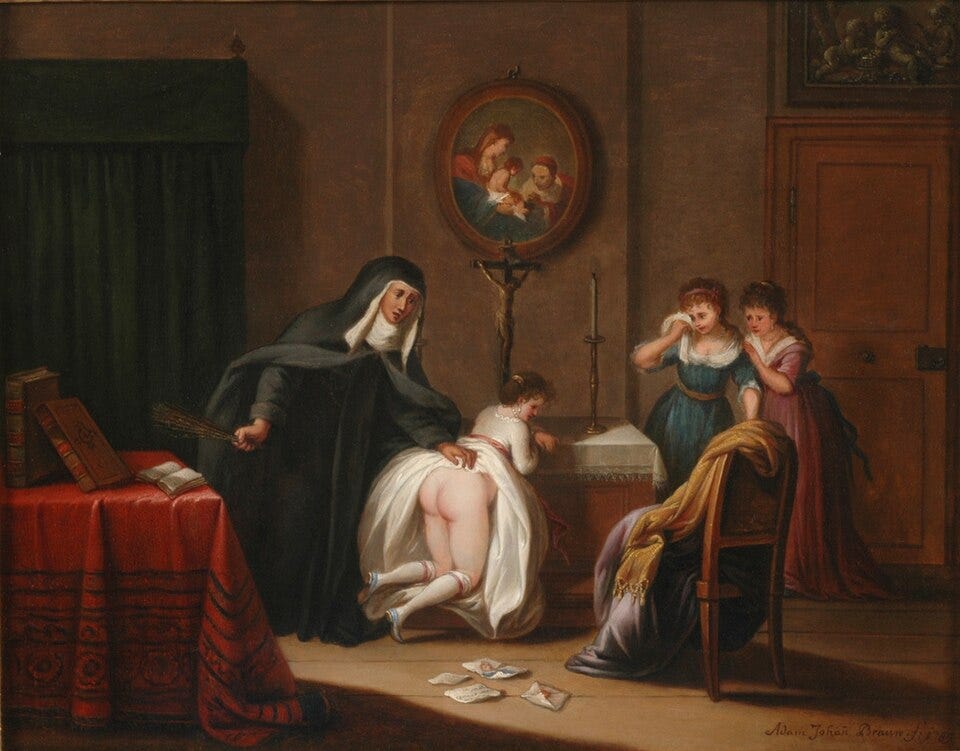
While my own interest as a raging homosexual lies entirely in other men, I shall try not to neglect those of other persuasions! The Catholic girls’ school is loaded with cultural associations, often the physical discipline given by nuns. In the majority of the United States, such punishment is still allowed in private schools, which was admittedly shocking to me. Especially to those older than myself or who grew up in different circumstances, physical punishment in school is a potent image, representing pure power of one person over another. Adding that religious component is quite strong, especially when punishment often takes place on one’s ass.
The nun looks dismayed as she holds the birch up to the young woman’s naked back, her dress pulled up like it would be in other engagements. Her friends look on weeping, but still as voyeurs. Above the scene hangs another painting, likely Mary holding Jesus – this is a moment of parental discipline. This is also done upon an altar, next to candles and a crucifix, nearly presenting this act as a form of worship or communion. The young woman’s letters lay scattered on the floor, and I would guess they’re love letters, especially with one appearing to be an illustration. The person in the illustration seems to have long hair…perhaps another woman? The girl preparing to be birched is depicted as already pure. Her skin untainted, her dress white and unstained. For what does she need discipline?
She will be unjustly sullied by violence, then. How unfair, and what an abuse of power. What else could a nun do with a young woman, hm?
Lightning Round of Related Things:
While I will cover What Manner of Man on its own at some point, I assume many of you who are here are already familiar with it. You may not know, however, that St. John Starling will be releasing a new book this year, A Companion in Vice. While it’s not about priests, check it out!
Check out the tumblr post here.
My partner and I have both been playing Bloodborne, and while he is much better at these games than I (he killed Lady Maria in one go, I nearly lost my marbles at Rom), there is a lot of intriguing and hot clergy to clear my mind. It isn’t the clergy of our world, but there is absolutely some sex appeal to the Healing Church if you like fictional hierophilia as well. The Choir masks are absolutely devious, leaving a mouth hole open for God knows what (talking, probably). Executioner Alfred is a big, polite vileblood-hating zealot; Father Gascoigne is an older man driven to beasthood; and if you really like your clergy monstrous, Vicar Amelia and some other characters who are total spoilers will be of interest.
Bloodborne, damn it all, is a Playstation exclusive, but a clever mind may find a workaround.
That’s all for the rest of April, but I shall see you after the end of this cruelest month. I will be deep in the trenches of reading and writing about Catholicism and can hopefully bring more things from it.
P.S. I hope the new pope will be hot!